
We can help you towing your car. By relying on the services of a professional and experienced team you put yourself in good hands. We will get the job done fast 24/7.
Core strength for truck drivers: Why it matters more than you think
When most people hear the word “core” teamed with the word “strength” or “muscles,” they think of six-pack abs or endless sit-ups. But real core strength has very little to do with how your stomach looks.
For truck drivers, core strength is about a few far more important things:
Stability. Strength. Less pain. Better movement. A longer career.
Your core is the foundation of every movement you make, from climbing into the cab to turning the wheel, stepping down from your truck, lifting freight, or simply getting out of the seat after hours on the road.
And when your core gets weak, your body feels it.
Why truck drivers need to pay attention to core strength
Driving for long hours means sitting for long hours. And while sitting may FEEL restful, too much of it can slowly weaken the muscles that are meant to support your spine, pelvis and hips. That can lead to:
Lower back pain;
Poor posture;
Tight hips;
Reduced balance;
Increased injury risk;
More stiffness getting in and out of the truck; and
Less confidence moving your body.
A strong core helps you stay stable, move better and reduce wear and tear on your body over time.
For drivers, this is not optional. It is essential.
Where are your core muscles?
Your core is not just your abs. It includes a group of muscles that wrap around your trunk like a natural support system:
Deep abdominal muscles;
Obliques (side waist muscles);
Lower back muscles;
Pelvic floor;
Diaphragm;
Glutes; and
Hip stabilizers.
Think of your core as your body’s built-in brace.
When these muscles work together, they help protect your spine and keep you strong during daily movement.
How long-term sitting weakens the core
When you sit for extended periods — especially with poor posture — several things can happen:
Deep abdominal muscles become less active.
Glutes weaken.
Hip flexors tighten.
Pelvis shifts out of alignment.
Lower back takes on extra stress.
Over time, your body begins to rely on compensation instead of strength. That is why so many drivers feel stiff, unstable, or sore when they stand up after driving.
Why core strength matters for both men and women
Core weakness does not discriminate.
For men, it can show up as back pain, loss of mobility, poor lifting mechanics and reduced physical confidence.
For women, it can also impact pelvic floor health, posture, balance and recovery after pregnancy or hormonal changes.
For everyone, it affects how well you age.
The stronger and more stable your core is now, the more freedom you keep later.
Why sit-ups are not the answer
Sit-ups are often the first thing people think of for core training. But for many people — especially those with tight hips, who suffer from back pain or endure long hours of sitting — sit-ups can create more strain than benefit.
They often overuse the hip flexors, pull on the neck and miss the deeper stabilizing muscles that matter most.
What truck drivers need is not more crunching; they need better bracing, control and stability.
Try these 3 moves to start building core strength today
These exercises can be done on the floor, in your sleeper, at home — anywhere you have space to lie down!
Single Leg Core Bracing
This move “teaches your core to stabilize while one side of the body moves.
How to do it:
Lie on your back with knees bent.
Lift one leg to 90 degrees (Image 1).
Press the opposite hand into your thigh (Image 2).
Resist the pressure with your leg.
Keep your pelvis steady and do not rock side to side.
Hold for 10 seconds.
Switch sides and repeat.
Repeat this 3 to 6 times for each side.
Single Leg Core Bracing (Photos courtesy of Mother Trucker Yoga)
Double Leg Core Bracing
This increases the challenge by using both sides at once.
How to do it:
Lie on your back.
Bring both legs up to 90 degrees (Image 3).
Cross your arms and press into each thigh (Image 4).
Resist with your legs.
Keep your pelvis stable.
Hold for 10 seconds.
Repeat this 3 to 6 times for each side.
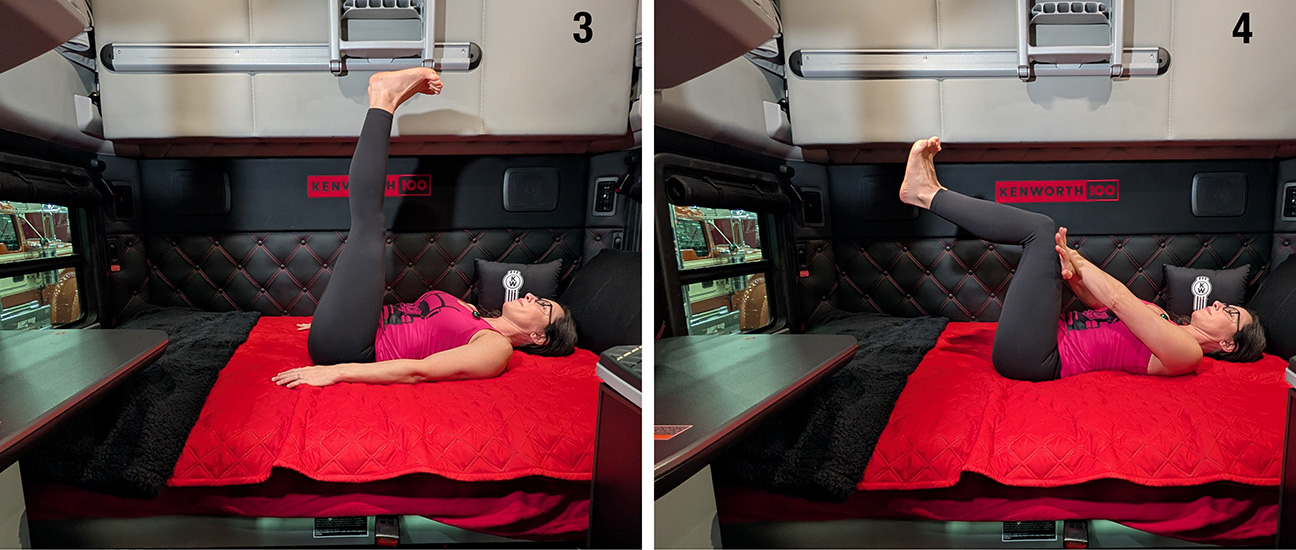 Double Leg Core Bracing (Photos courtesy of Mother Trucker Yoga)
Single Leg Drop
This improves control while the legs move independently.
How to do it:
Lie on your back.
Extend both legs toward the ceiling.
Keep one leg still.
Slowly lower the other leg only as far as you can without your pelvis shifting.
Bring the leg back up.
Repeat on the other side.
The goal: Move slowly and with control.
Modifications
Need to make it more comfortable? No problem! Try these adjustments:
Place a pillow under your head to open the chest and neck.
For the Single Leg Drop, bend both knees. Instead of lowering a straight leg, drop your heel from the hip.
Reduce range of motion if you feel your back arching or pelvis rocking.
Remember, good form matters more than going big.
Why core strength matters long-term
You do not need a six-pack — you need a body that supports you.
Strong core muscles can help you:
Drive with less pain;
Improve posture;
Protect your back;
Move with more confidence;
Stay active longer; and
Feel stronger on and off the road.
Final thoughts
Your core is not just the center of your body: It is the center of how you move, how you feel and how long you stay strong enough to keep doing what you love.
Start small, stay consistent and let every rep be one more mile toward a stronger future.
Hope Zvara is a regular contributor to The Trucker, providing tips for healthy living on the road as well as tips to control stress. She is also the CEO of Mother Trucker Yoga and Road Relief Wellness. She has been featured in Forbes and Yahoo News, and is a regular guest on SiriusXM Radio. Her practical strategies show drivers how they can go from unhealthy and out of options to feeling good again.
Copyright © 2024 FastTowing247.com. All Rights Reserved.